
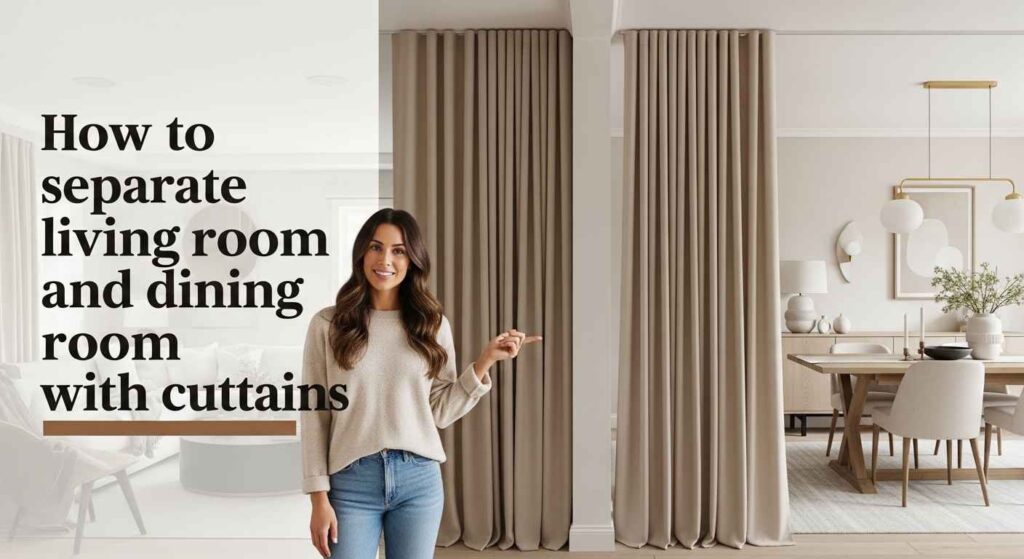
Open-plan homes often need flexible solutions for creating separate living and dining zones without building walls. Curtains can divide open spaces effectively when installed with ceiling tracks or rods, using full-length panels and correct measurements to ensure privacy, light control, and clear zoning. This makes separating the living room and dining room with curtains a practical, stylish, and renter-friendly interior solution for modern layouts.
The Correct Way to Use Curtains as a Room Divider
Mount curtains as high as possible (preferably ceiling-mounted), use floor-to-ceiling panels, choose 2–2.5× fabric fullness for proper coverage, and select heavy or layered fabrics for privacy, sound control, and clean visual zoning between living and dining areas.
Ceiling vs. Wall Mount
- Ceiling mount: Best for true room division. It creates a continuous vertical line from ceiling to floor, blocks light gaps at the top, and looks like a built-in partition.
- Wall mount: Works only when ceiling mounting isn’t possible. It may leave small top gaps and feels more like a window curtain than a divider.
Floor-to-Ceiling Length Rule
Curtain panels must start just below the ceiling/track and end touching or slightly grazing the floor. Short curtains break the visual partition and make the divider look decorative instead of functional.
Width & Overlap Rule (2–2.5× Fullness)
Measure the total opening between the living and dining areas and multiply it by 2 to 2.5. This extra fabric fullness:
- Prevents light and privacy gaps
- Improves sound absorption
- Creates a rich, solid partition look instead of a flat sheet
Best Fabrics for Curtain Room Dividers
- Velvet: Maximum privacy, sound dampening, luxury look
- Blackout polyester blends: Best for blocking light and smells between spaces
- Thick linen: Breathable, soft separation with natural texture
- Layered sheer + heavy panel: Flexible control of light and privacy
What Type of Curtains Work Best for Room Separation?

The best curtains for separating a living room and dining room are floor-to-ceiling, full-width panels made from heavy or layered fabrics. They create visual zoning, improve privacy, reduce noise/light transfer, and look like a built-in partition rather than a window treatment.
Sheer vs Blackout vs Heavy Fabrics
- Sheer curtains: Good for soft visual separation while keeping both spaces bright and connected. Minimal privacy and no sound control.
- Blackout curtains: Strong privacy, blocks light, helps contain cooking smells and temperature flow between rooms.
- Heavy fabrics (velvet/thick linen): Best overall for room division—adds weight, absorbs sound, and creates a solid partition feel.
Floor-to-Ceiling Panels for Visual Division
Curtains used as dividers must run from ceiling to floor. This creates a continuous vertical barrier that clearly defines living and dining zones. Short panels make the setup look decorative instead of functional.
Single-Panel vs Double-Panel Divider
- Single wide panel: Slides to one side, simple look, suitable for small openings.
- Double panels (centre opening): Better coverage, balanced appearance, easier movement, and fewer privacy gaps.
Best Materials for Curtain Room Dividers
- Linen: Natural texture, breathable separation, ideal for modern interiors.
- Velvet: Dense, luxurious, excellent for privacy and sound dampening.
- Polyester blends (blackout): Practical, affordable, blocks light and airflow between spaces.
Step-by-Step Installation Guide (With Measurements)
Install a ceiling-mounted track or heavy rod across the opening, use floor-to-ceiling curtains, and size the fabric to 2–2.5× the opening width. Correct marking, proper anchors, and the right hardware are what make the divider look built-in and function like a real partition.
Tools & Hardware Required
- Measuring tape, pencil, level
- Drill with wall/ceiling anchors and screws
- Ceiling curtain track or heavy-duty curtain rod
- Curtain brackets/track clips
- Step ladder
- Curtain panels (fullness calculated)
How to Measure Width Between Living and Dining
- Measure the total open span where you want the divider.
- Multiply this width by 2 to 2.5 for proper curtain fullness.
- This final number is the total curtain fabric width you need (split into 1 or 2 panels).
Example: Opening = 8 ft → Curtain width needed = 16–20 ft total fabric.
Where Exactly to Mount (Ceiling Line Marking)
- Mark a straight line 2–4 inches away from the true edge of the living/dining boundary so curtains can slide freely.
- Use a level to draw a perfectly straight ceiling line.
- Mount the track/rod as close to the ceiling as possible to remove top light gaps and create a full partition look.
Curtain Track vs Curtain Rod (When to Use Each)
- Ceiling curtain track: Best for wide spans, heavy curtains, smooth sliding, and a seamless built-in appearance.
- Heavy curtain rod: Suitable for smaller openings and lighter fabrics where ceiling drilling isn’t preferred.
Rental-Friendly No-Drill Method
- Use tension rods for narrow passages.
- Use adhesive ceiling hooks with lightweight tracks for temporary setups.
- Choose lighter fabrics (linen/polyester) to reduce load on no-drill supports.
This method allows room separation without permanent damage to walls or ceilings.
Curtain Track vs Curtain Rod for Room Dividers
A ceiling curtain track is better for modern, seamless room separation and heavy fabric support, while a curtain rod is more traditional and works best for lighter dividers or smaller openings.
Comparison Table
| Feature | Ceiling Track | Heavy Curtain Rod |
|---|---|---|
| Best for | Large open spaces, full room separation, modern open-plan homes | Small to medium openings, simple DIY setups, traditional interiors |
| Look | Minimal, built-in, hotel-style seamless partition | Visible hardware, decorative, slightly bulkier appearance |
| Movement | Smooth sliding, glides easily across long spans | Can be slightly stiff depending on rod and curtain weight |
| Weight support | Strong support for heavy fabrics (velvet, blackout, layered curtains) | Moderate support; best for light to medium-weight curtains |
| Privacy seal | Excellent—closer ceiling fit reduces light gaps and improves separation | Moderate—small gaps at top/sides may reduce full privacy |
If your goal is a real functional room divider (living + dining separation), go with a ceiling track system. If you want a lighter visual separation or budget-friendly setup, a curtain rod is enough.
Solving Open Floor Plan Problems with Curtain Partitions

Curtain partitions are a flexible solution for open floor plans because they create temporary zones, improve privacy, and control light, smell, and noise without building permanent walls—making living and dining areas feel structured but still open.
Creating Zones Without Walls
Curtains allow you to visually divide one large space into two functional areas. This helps define a living zone for relaxation and a dining zone for meals without losing the open-plan feel. When pulled closed, they act like a soft wall; when open, the space feels unified.
Privacy When Guests Arrive
In open layouts, everything is visible at once. Curtain dividers give instant privacy by hiding the dining or living area when needed—especially useful when hosting guests, cleaning, or switching between daily activities.
Blocking Kitchen Smell from Dining
If your dining area is near the kitchen, curtains act as a soft barrier for airflow, helping reduce the spread of cooking odours into the living space. Heavy or layered fabrics work best for this purpose.
Reducing Noise Transfer
Thick curtain materials like velvet or blackout polyester help absorb sound waves, reducing noise from TV, conversations, or kitchen activity between zones. While not fully soundproof, they noticeably soften echo and noise flow.
Improving AC / Temperature Efficiency
Curtains help control air circulation by separating cooled or heated zones. This improves AC efficiency in summer and helps retain warmth in winter by reducing direct air exchange between living and dining areas.
Managing Natural Light Between Spaces
Curtain partitions allow flexible light control. Sheer fabrics let natural light pass through both areas, while blackout or heavy curtains can fully block light when privacy or reduced brightness is needed.
Design & Styling Ideas for Curtain Room Dividers
Curtain room dividers are both functional and decorative. The right style, colour, and fabric can transform a simple curtain into a modern, luxury, or space-enhancing design feature that clearly separates or visually connects living and dining areas.
Modern Minimalist Divider Looks
Modern minimalist designs focus on clean lines, neutral tones, and floor-to-ceiling simplicity. Use plain fabrics like white, beige, or light grey with hidden ceiling tracks to create a seamless wall effect. The goal is to separate spaces without visually cluttering the room.
Luxury Hotel-Style Curtain Partitions
To achieve a hotel-inspired look, choose heavy fabrics like velvet or high-quality blackout curtains in deep tones such as charcoal, navy, or emerald. Full-height ceiling tracks and wide pleats create a rich, structured appearance similar to luxury suites.
Curtain Colour Ideas for Living + Dining Harmony
Colour plays a key role in visual flow between spaces:
- Neutral tones (beige, off-white, taupe): Create unity and softness
- Dark tones (navy, charcoal): Add contrast and definition
- Earth tones (olive, sand, brown): Warm and balanced feel
The goal is to ensure both areas feel connected but still visually distinct.
Small Apartment Divider Ideas
In smaller spaces, use lightweight or semi-sheer curtains to avoid making the room feel tight. Opt for soft colours and slim ceiling tracks. Sliding curtains instead of bulky panels help maintain openness while still creating separation when needed.
Matching Curtains with Furniture & Lighting
For a cohesive interior look, match curtain style with the following:
- Furniture tone: neutral curtains with wooden furniture, bold curtains with modern minimal setups
- Lighting: warm lighting pairs well with beige and earthy curtains, while cool lighting suits grey and white tones.
- Accessories: rugs, cushions, and wall art should share similar colour undertones for visual balance
Curtains vs Other Room Dividers (What Works Better?)
Curtains are the most flexible, budget-friendly, and space-efficient way to separate a living room and dining room, while other dividers like screens, shelves, and wooden partitions offer more structure but reduce flexibility and open space flow.
Comparison Table
| Divider Type | Cost | Privacy | Flexibility | Aesthetic | Space Use |
|---|---|---|---|---|---|
| Curtains | Low to medium | Medium to high (depends on fabric) | Very high (open/close anytime) | Soft, modern, customizable | Excellent (space-saving) |
| Folding screens | Medium | Medium | High (portable) | Decorative but bulky | Moderate (takes floor space) |
| Shelves | Medium to high | High | Low (fixed structure) | Functional but heavy visual look | Reduces open space |
| Wooden partitions | High | Very high | Low (permanent) | Premium, architectural look | Reduces openness significantly |
| Rugs / paint zoning | Low | Low | Very high (no physical barrier) | Subtle visual zoning only | Maximum openness |
Key Insight (What Works Better?)
- Best overall for flexibility + budget: Curtains
- Best for strong permanent separation: Wooden partitions or shelves
- Best for light visual zoning only: Rugs or paint
- Best portable option: Folding screens
If you want a solution that balances privacy, cost, and design flexibility, curtains outperform most room dividers—especially in modern open living-dining layouts where space control needs to stay adaptable.
Common Mistakes That Make Curtain Dividers Look Cheap

Curtain dividers look cheap mainly when they are too short, poorly mounted, or made from the wrong fabric. Most design issues come from incorrect height, insufficient fabric width, weak hardware support, and light gaps that break the clean room-dividing effect.
Curtains Too Short
Curtains that do not reach the floor break the vertical flow and instantly make the divider look unfinished. For a proper room separation effect, panels should always touch or slightly graze the floor.
Rod Mounted Too Low
When the rod or track is installed below ceiling level, it visually shrinks the room and exposes gaps at the top. A higher (ceiling-close) installation creates a seamless, built-in partition look.
Not Enough Fabric Fullness
Using less fabric width makes curtains look flat and thin. A proper divider requires 2–2.5× fullness of the opening width to create rich folds and full coverage.
Wrong Fabric Choice
Lightweight or sheer-only fabrics can look weak as dividers. For a premium feel, use heavy or structured materials like velvet, blackout polyester, or thick linen blends.
Sagging Rod Problem
Weak rods or poor installation cause bending in the middle, especially on wide openings. This creates an uneven, unprofessional look. Always use heavy-duty rods or ceiling tracks for stability.
Light Leakage Gaps
Visible gaps on the sides or top reduce privacy and make the divider look incomplete. Proper overlap, ceiling mounting, and correct width sizing help eliminate light leakage and improve visual separation.
Real Layout Examples (Different Room Shapes)
The best curtain room divider layout depends on your room shape and opening size. Wide, narrow, studio, and open-plan layouts each require different curtain widths, mounting methods, and fabric choices to create effective separation between the living room and dining room while maintaining balance and functionality.
Wide Opening Between Rooms
For large openings, use ceiling-mounted tracks with wide double panels. The curtain should extend 2–2.5× the width of the opening to ensure full coverage and smooth visual separation without gaps. Heavy fabrics work best to maintain structure across wide spans.
Narrow Passage Layout
In narrow spaces, a single-panel curtain or slim track system works best. Keep fabric lightweight or medium-weight to avoid crowding the passage. This setup provides flexible separation without making the area feel tight or blocked.
Studio Apartment Setup
Studio layouts need multi-functional curtain zoning, where the divider separates sleeping, living, and dining areas. Use floor-to-ceiling curtains in neutral tones to maintain openness while still creating defined zones for privacy and function.
Large Open Concept Living/Dining
In open-plan homes, install a long ceiling track across the entire boundary line between living and dining. Use layered or heavy curtains to create a strong visual break while still allowing the space to feel connected when the curtains are open.
When Curtains Are NOT a Good Room Divider
Curtains are not a good room divider when you need complete soundproofing, maximum privacy, strong odour control, or a permanent wall-like partition. They work best for flexible visual separation but cannot fully replace solid walls or fixed room dividers.
When You Need Full Soundproofing
Curtains cannot fully block sound. For offices or noisy kitchen separation, solid walls or acoustic panels work better for true noise control.
When Maximum Privacy Is Required
If you need complete visual and physical privacy, curtains may fall short due to slight gaps or light leakage at the edges and top.
When Odour Control Must Be Strong
Curtains can slow airflow but cannot fully block strong kitchen or cooking smells. Solid doors or partitions are more effective.
When High Durability Is Needed
In high-traffic areas or homes with pets and children, curtains may wear out faster compared to rigid partitions like wood or drywall.
When Structural Division Is Permanent
Curtains are flexible and temporary. If you need a permanent architectural separation, fixed walls or wooden partitions are better.
Curtains are best for flexible, decorative, and temporary room separation but not suitable for situations requiring soundproofing, full privacy, odour control, or permanent division.
Conclusion
Understanding how to separate a living room and dining room with curtains is all about choosing the right fabric, proper ceiling or rod installation, and correct width and height to create a functional and stylish division between spaces. Curtains offer a flexible and affordable way to define zones in open floor plans while maintaining light flow and interior harmony, but their effectiveness depends on correct setup and material choice.
1. Can curtains really divide a room?
Yes, curtains can effectively divide a room by creating a visual and functional separation between spaces like living and dining areas, especially when installed from ceiling to floor with proper width coverage.
2. What fabric is best for a curtain room divider?
Heavy fabrics like velvet, blackout polyester, and thick linen blends work best because they provide better privacy, structure, and partial sound and light control.
3. Do curtain dividers block sound?
Curtain dividers only reduce sound slightly. They can soften noise, but they do not fully block sound like solid walls or acoustic panels.
4. Are they good for privacy?
Yes, curtain dividers provide good visual privacy, especially when using thick or layered fabrics, but they may not offer complete isolation due to possible light gaps.
5. How wide should the curtain be?
The curtain should be 2 to 2.5 times wider than the opening to ensure full coverage, proper folds, and effective room separation without gaps.
6. Are curtain dividers renter-friendly?
Yes, curtain dividers are very renter-friendly because they can be installed with tension rods or removable ceiling tracks, allowing separation without permanent damage.

I’m Attaur Rahman, founder of DecorReviewHub. I test and review curtains and home decor products to help homeowners make the right choice for every room. All my guides are based on real use and honest comparisons.