
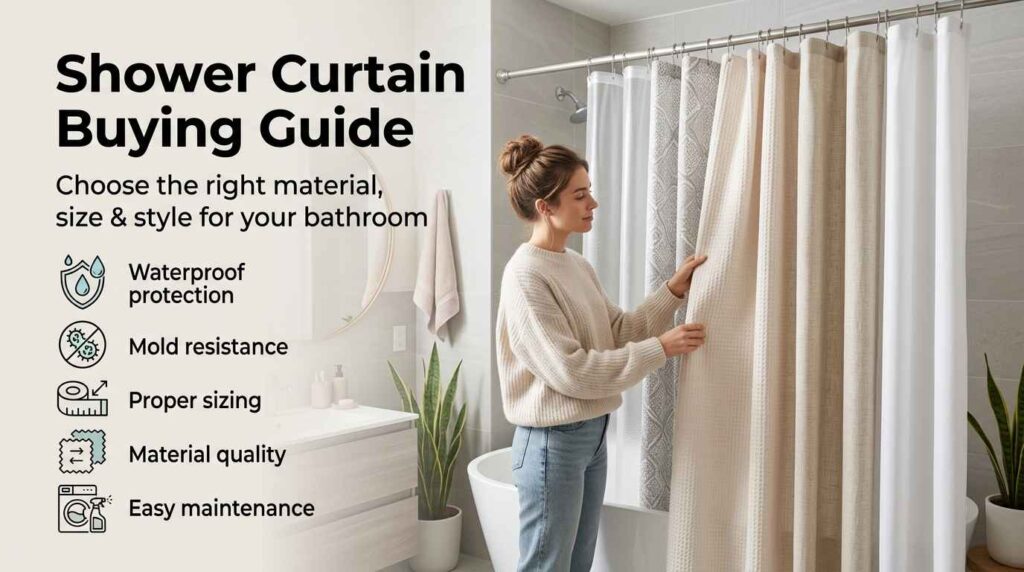
Most people pick a shower curtain by colour. Three weeks later, they’re scrubbing black mould off the bottom hem.
The right shower curtain depends on material, weight, and how well it fits your bathroom’s humidity level — not just how it looks. This guide covers everything: waterproof options, mould-resistant fabrics, size charts, liner rules, and honest product picks for every budget.
What to Look for in a Shower Curtain
Use this checklist before every purchase. It takes one minute and prevents costly mistakes.
- Waterproof rating — Is it self-contained, or does it need a liner?
- Mould resistance — Does it dry fast? Slow-drying fabrics develop mildew within weeks.
- GSM weight — Under 120 GSM billows and wears out fast. 180 GSM and above holds its shape.
- Size — Dimensions — Standard 72×72-inch curtains suit nearly all bathtubs. Walk-in showers and clawfoot tubs need different sizing.
- Liner requirement — PEVA and vinyl need no liner. Cotton, linen, and polyester almost always do.
- Machine washable — Non-washable curtains get wiped down or thrown out. Washable ones last much longer.
- Certifications — Look for PHTHALATE-FREE and OEKO-TEX-certified labels, especially for children’s bathrooms. Low-grade PVC releases VOCs (volatile organic compounds) that create the sharp “new plastic” smell.
- Hardware fit — Standard rings need a rod up to 1.25 inches wide. Hookless curtains attach directly to the rod — no rings needed.
Types of Shower Curtain Materials
Material determines how a shower curtain performs over time. Here is an honest breakdown of every major type.

PEVA and EVA — Best Budget Option
PEVA (polyethylene vinyl acetate) is the most widely used shower curtain material in the US. It is 100% waterproof, chlorine-free, and requires no liner.
Available in 3-gauge (thin) to 8-gauge (hotel-quality). For daily home use, 6-gauge PEVA hits the right balance of durability and flexibility.
One limitation: PEVA does not stop mould — it just repels water. If left bunched after showers, mildew appears within 2 to 3 weeks. Always spread the curtain fully across the rod to dry.
EVA (ethylene vinyl acetate) is a softer version of PEVA. Less plasticky, dries just as fast, and is slightly easier to fold.
- Best for: Guest bathrooms, rentals, no-liner setups, tight budgets
- Not ideal for: High-humidity bathrooms with zero ventilation
Polyester Fabric Shower Curtains
Polyester gives a real fabric look without the high maintenance of cotton. It is machine washable, quick-drying, and colour-stable over time.
Key spec: 180 GSM is the residential industry standard. At this weight, the curtain hangs well, resists billowing, and holds shape through repeated washing.
Most polyester curtains have a water-repellent coating that fades after 6 to 8 washes. After that, pair it with a PEVA or antimicrobial polyester liner.
Premium versions have 14+ rust-resistant grommets and a reinforced header tape — this distributes weight evenly and prevents sagging.
- Best for: Master bathrooms, everyday family use, and fabric aesthetics with easy care
- Not ideal for no-liner setups unless the curtain has a built-in waterproof coating
Cotton and Canvas Shower Curtains
Cotton is the most breathable option. Natural fibres absorb some ambient moisture, which actually reduces overall bathroom dampness when paired with a liner.
The trade-off is maintenance. Cotton curtains require cleaning every few weeks and usually dry more slowly after washing. In poorly ventilated bathrooms, mildew builds up fast.
Canvas is a heavier cotton weave – more structured, better natural drape. Popular in farmhouse and Scandinavian bathrooms. Both always require a liner.
- Best for: Well-ventilated bathrooms, natural material preference, farmhouse aesthetics
- Not ideal for: Small bathrooms without a window or exhaust fan
Vinyl (PVC) Shower Curtains
Vinyl is 100% waterproof, extremely heavy, and the most effective at staying in place during showers.
The drawback: off-gassing. Traditional PVC releases VOCs for days or weeks after opening — that sharp chemical smell. Caused by phthalates and chlorine compounds in PVC manufacturing.
Commercial-grade vinyl (hospitals, gyms, and hotels) uses stabilised PVC with minimal off-gassing and survives industrial laundering. Standard consumer vinyl has been largely replaced by PEVA.
- Best for: Utility and commercial bathrooms, maximum water containment
- Not ideal for en-suite bathrooms, households with children or asthma sufferers
Linen and Linen-Look Shower Curtains
Linen curtains sit at the premium end of the market. True linen has a distinctive texture and relaxed drape that feels effortlessly elegant.
In practice, most “linen” curtains are a linen-polyester blend or linen-cotton mix. Blends are more durable, easier to wash, and more moisture-resistant than pure linen. Pure linen needs delicate washing and slow drying.
Linen look works in neutral palettes — white, cream, taupe, and warm grey. Always requires a liner.
- Best for: Master bathrooms, spa or coastal aesthetics, and premium looks
- Not ideal for: High-humidity spaces without proper liner and ventilation
Material Comparison Table
| Material | Waterproof | Mold Resistance | Liner Needed | Machine Wash | Price | Best Use |
|---|---|---|---|---|---|---|
| PEVA (6-gauge) | 100% | Medium | No | Hand wipe | $ | Budget, guest bath |
| Polyester (180 GSM) | With coating | High | Yes | Yes | $$ | Everyday, master bath |
| Cotton / Canvas | No | Low | Yes | Yes | $$ | Ventilated, natural aesthetic |
| Vinyl (PVC) | 100% | Medium | No | No | $ | Utility, commercial |
| Linen / Linen-look | No | Medium | Yes | Gentle cycle | $$$ | Spa, luxury |
Shower Curtain Sizes: Complete Guide
Choosing the incorrect curtain size is among the most frequent bathroom setup mistakes. Here are all standard dimensions.
| Size | Dimensions | Best For |
|---|---|---|
| Standard | 72×72 inches | Most tub-shower combos |
| Extra Long | 72×84 inches | Ceilings above 8 feet, walk-in showers |
| Extra Wide | 108×72 or 108×84 | Double rods, oversized stalls |
| Stall Size | 54×78 inches | Standalone stall showers |
| Clawfoot Tub | 180×70 inches | Wraparound ceiling-mounted rod |
How to Measure Your Shower Correctly
Step 1 — Width: Measure your shower opening. Add 12 inches total (6 per side) so the curtain extends past the edges and prevents water escape.
Step 2 — Length: Measure rod to floor. Standard curtains hang 1 to 2 inches above the floor.
Step 3 — Ring drop: Standard shower rings add about 1 inch between the rod and the curtain header. Factor this into your length.
Do You Need a Shower Curtain Liner?
Your curtain material completely determines the answer.
No liner needed:
- PEVA (any gauge)
- Vinyl / PVC
- Polyester with built-in waterproof coating
Liner required:
- Cotton or canvas
- Linen or linen-look
- Standard polyester without waterproof coating
- Any decorative fabric curtain
Choosing the Right Liner
Two main liner types: PEVA and antimicrobial polyester.
PEVA liners — Inexpensive, immediately waterproof, no washing needed.
Antimicrobial polyester liners are more expensive, machine washable, and contain silver-ion or zinc-based antimicrobial treatment that actively fights mould rather than just repelling water.
Liner gauge guide:
- 3-gauge — Thin, lightweight, guest bath or occasional use only
- 6-gauge — Standard daily use, good balance
- 8-gauge — Heavy-duty, best for primary bathrooms with daily heavy use
How Bathroom Humidity Affects Your Curtain
Every hot shower spikes bathroom humidity to 80–100% relative humidity. Without ventilation, that moisture saturates every surface.
Curtains left bunched at the tub edge trap moisture in folds. Soap scum on the lower hem acts as a food source for mould spores. The result: black mould and pink mildew within weeks.
The 3-Step Mould Prevention Routine
- Step 1: Spread the curtain fully across the rod immediately after every shower. This halves drying time.
- Step 2: Run the exhaust fan for 20 minutes after showering. No fan? Open the door or window.
- Step 3: Wash every 2 to 4 weeks. For PEVA and vinyl, wipe with one part white vinegar to four parts water.
Shower Curtain Problems and Solutions

Problem: The curtain billows inward and sticks to your body.
Hot water creates a pressure differential – warm air rises, pulling cool air in from the curtain bottom.
Fix: Choose a curtain with a weighted hem. Add suction cup magnets that attach the curtain base to the tub wall. Or install a curved shower rod that pushes the curtain 4 to 6 inches outward.
Problem: Black mould appears within weeks.
The curtain is not drying between uses.
Fix: Spread the curtain after every shower. Run the exhaust fan. Switch to a quick-dry polyester curtain and an antimicrobial liner if the problem continues.
Problem: Strong chemical smell after opening
Off-gassing from VOCs in low-quality PVC or PEVA.
Fix: Choose PHTHALATE-FREE and OEKO-TEX-CERTIFIED curtains. Air out new curtains outdoors for 24 to 48 hours before hanging.
Problem: Rings rust and stain the curtain header.
Standard steel rings corrode in humid environments.
Fix: Replace with zinc-alloy or stainless steel rust-resistant rings. They glide better, last longer, and leave no stains.
Problem: The curtain leaves a gap at the bottom.
The curtain length is too short for the rod height.
Fix: Switch to a 72×84 inch (extra long). Or lower the rod position slightly if space allows.
Shower Curtain Gauge and Weight Guide
PEVA and Vinyl — Gauge Numbers
| Gauge | Thickness | Best For |
|---|---|---|
| 3-gauge | Very thin | Guest bath, occasional use |
| 6-gauge | Standard | Daily family use |
| 8-gauge | Heavy-duty / hotel quality | Primary bath, heavy daily use |
Polyester Fabric — GSM Weight
| GSM | Feel | Performance |
|---|---|---|
| Under 120 GSM | Thin, cheap feel | Billows, wears fast |
| 180 GSM | Solid, structured | Industry standard for home use |
| 200+ GSM | Premium, drapery-like | Best hang, most light blocking |
Top Shower Curtain Picks for 2026
After testing dozens of options across PEVA liners, fabric curtains, extra-long panels, and decorative styles, these five shower curtains stand out for 2026. Each pick is evaluated on waterproof performance, fabric weight, mould resistance, ease of care, and value — so whether you need a budget PEVA liner, a machine-washable fabric option, or a farmhouse-style curtain that actually holds its shape, the right choice is here.
AmazerBath Shower Curtain Liner 2 Pack — Best Budget PEVA Liner

Made from 100% PEVA — chlorine-free, phthalate-free, and odourless out of the box — this liner needs no separate waterproofing layer. The standard 72×72 inch size fits most tub-shower combinations, and the pack-of-two format means a fresh replacement is always on hand. Twelve rustproof metal grommets run along the reinforced header, and the transparent light-filtering material keeps smaller bathrooms feeling open and bright.
Three weighted stones along the bottom hem anchor the liner flush against the tub wall, eliminating the billowing caused by hot shower air pressure. Maintenance is simple: a quick wipe with white vinegar solution removes soap scum and prevents mildew buildup along the lower panels. For a budget PEVA liner that genuinely holds its own in high-humidity bathrooms, this is the most reliable option at this price point.
ALYVIA SPRING Waterproof Fabric Shower Curtain Liner — Best Machine-Washable Liner

This 100% polyester liner earns its overall pick status by replacing the plastic smell and limited lifespan of standard PEVA with a soft, odourless, PVC-free and BPA-free fabric that works just as well in wet environments. A premium waterproof coating is applied directly to the tightly woven material, keeping bathroom floors dry without the stiff, plasticky feel of traditional liners. Rustproof metal grommet eyelets along the reinforced header allow clean, smooth hanging on any standard shower rod, and 25+ colour options mean it doubles as a standalone curtain in minimalist setups.
Three embedded magnets along the weighted hem hold firmly against the tub wall, preventing billowing without extra hooks or clamps during showers. The quick-dry polyester construction reduces moisture retention between uses — the main driver of mildew along the lower hem. Machine wash on a gentle cold cycle every two to three weeks keeps it fresh indefinitely, making the $9.98 price one of the strongest value propositions in the fabric shower liner category.
GORILLA GRIP Textured Shower Curtain — Best Heavy-Duty Fabric Curtain

At 230 GSM — well above the 180 GSM residential standard — this curtain has enough mass to hang flat and resist billowing without clips or weights. The woven textured pattern works across modern, transitional, and farmhouse bathroom styles, and the oversized 72×78-inch dimensions provide extended floor coverage for bathrooms with higher rod placements or walk-in shower configurations where standard 72×72 curtains leave a gap.
Twelve heavy-duty rust-resistant grommets handle both decorative rings and standard hooks without loosening over time. The wrinkle-resistant and fade-resistant fabric holds its texture and colour through repeated machine wash cycles — a practical edge over mid-range curtains that degrade after six to eight washes. The 230 GSM weight also provides meaningful light-blocking capability, making a separate decorative outer panel optional for most users.
MIULEE 84″ Long Scalloped Shower Curtain — Best Extra-Long Linen-Look Curtain

The 72×84 inch dimensions solve a real problem: bathrooms with elevated rod placements or above-standard ceiling heights, where a standard curtain leaves an exposed gap at the floor. The faux-linen two-yarn parallel weave creates the organic texture of natural linen without the high-maintenance care, and the scalloped bottom edge with a black contrast border adds a tailored finish that reads more expensive than the price reflects. The cream beige colourway pairs cleanly with white subway tile, natural stone, wood tones, and chrome or matte black fixtures.
The upgraded faux linen fabric is denser than standard weave alternatives, providing genuine privacy without a separate blackout liner. The advanced water-repellent treatment causes water droplets to roll off rather than soak through during normal shower use. Twelve rust-resistant metal hooks are included — no separate hardware purchase needed. Machine wash cold on a gentle cycle with mild detergent to keep it looking sharp across 25+ available colour options.
Blgiont Vintage Blush Floral Shower Curtain — Perfect for Rustic Cottage & Farmhouse Bathrooms

Few printed curtains in this price range successfully translate a specific aesthetic — cottagecore, vintage farmhouse, or boho-floral — without looking mass-produced. The retro floral pattern on a pink-taupe base uses dusty pink, warm cream, soft botanical green, and aged ivory tones that feel curated rather than trend-chasing. At 210 GSM, the faux linen fabric hangs with natural drape and avoids the transparent, flimsy appearance that undermines lighter printed curtains at similar price points.
Twelve clear acrylic hooks are included, maintaining visual continuity with the vintage aesthetic better than standard chrome rings would. The standard 72×72 inch size fits most tub-shower combinations, with a 72×84 inch extra-long option available. Machine wash cold on a gentle cycle — and pair with a separate waterproof liner for full water containment, as with any decorative fabric curtain. The 4.8-star rating across 140 reviews reflects consistent delivery on its visual promise for farmhouse and cottage-style bathrooms.
Shower Curtain Styles for Every Bathroom

Shower curtain style affects the entire bathroom’s look and feel. Whether your space is modern, farmhouse, bohemian, coastal, or hotel-inspired, the right fabric, pattern, and colour choice ties the room together. Here’s how to match curtain style to your bathroom design.
Modern and Minimalist
Solid colours only — white, warm grey, taupe, or charcoal. Clean grommets and no busy patterns. Hookless curtain systems reinforce the uncluttered look.
Farmhouse and Rustic
Cotton canvas, linen-look polyester, or ticking stripes in neutral tones. Wooden rings on a brushed bronze or matte black rod. Waffle weave and seersucker textures work well here.
Bohemian and Eclectic
Pattern-forward: macramé panels, tassel trim, mandala prints, earthy tones (terracotta, burnt orange, sage green). Pair a patterned outer curtain with a simple white liner.
Hotel and Spa-Inspired
Crisp white 180 GSM polyester curtain with a heavy 8-gauge liner. Some buyers add a second decorative outer panel. Brushed nickel or chrome rings on a tension rod complete the look.
Coastal and Nautical
Stripes in navy and white, seafoam and sand, or coral and cream. Lightweight polyester or cotton. Rope-style tiebacks add a finishing nautical detail.
How to Hang a Shower Curtain Correctly
Rod height: 75 to 77 inches from the floor. This gives a 72-inch curtain 3 to 5 inches of floor clearance — enough to stay dry without leaving a gap.
Floor clearance: Aim for 1 to 2 inches. More than 2 inches and water escapes underneath it. Less, and the hem sits in standing water constantly.
Ring spacing: Use all 12 grommets evenly across the rod. Uneven spacing causes sagging and uneven wear.
Curved rods: Extend 4 to 6 inches outward from the wall. This adds interior shower space and reduces curtain billowing significantly.
Shower Curtain vs Shower Door: Quick Comparison
| Factor | Shower Curtain | Shower Door |
|---|---|---|
| Upfront cost | $30–$80 | $200–$1,500+ |
| Installation | No tools needed | Professional install |
| Cleaning | Machine wash or replace | Squeegee + track scrubbing |
| Lifespan | 6–18 months | 10–20 years |
| Flexibility | Change anytime | Permanent |
| Water containment | Good with weighted hem | Excellent |
| Best for | Renters, design flexibility | Long-term homeowners |
How Often to Replace a Shower Curtain
| Type | Replace Every |
|---|---|
| PEVA / Vinyl | 6 to 12 months |
| Polyester (180 GSM) | 18 to 24 months |
| Cotton / Linen | 2 to 3 years |
| PEVA Liner | 4 to 6 months |
| Antimicrobial Polyester Liner | 12 to 18 months |
Replace sooner if mold does not wash out, the material yellows, or the hem tears.
Final Thoughts
The right shower curtain depends on three things: your bathroom’s humidity level, your aesthetic preference, and how much maintenance you will realistically do.
Good ventilation? A fabric curtain in polyester, cotton, or linen-look creates a refined, hotel-like result. Persistent moisture or poor airflow? A quality PEVA curtain with a weighted hem and antimicrobial liner is the smarter long-term choice.
Focus on GSM weight and gauge over price. A 180 GSM polyester curtain at $35 outlasts three $12 replacements. Quality materials always pay off in reduced hassle.
FAQs
1. What material is best for a shower curtain?
For most homes: 180 GSM polyester curtain paired with a 6-gauge PEVA or antimicrobial polyester liner. Best balance of aesthetics, durability, and easy maintenance. Want no liner? 6-gauge PEVA is the most practical single-purchase solution.
2. Do I need a liner with a fabric shower curtain?
Yes — almost always. Polyester, cotton, and linen are not waterproof on their own. The liner handles waterproofing. The outer curtain handles appearance.
3. What is PEVA and is it safe?
PEVA (polyethylene vinyl acetate) is chlorine-free and does not contain phthalates or chlorinated compounds. Much safer than standard PVC. Choose PHTHALATE-FREE and OEKO-TEX certified for maximum safety.
4. How do I stop my shower curtain from billowing inward?
Four options: weighted hem, suction cup magnets on the tub wall, a curved shower rod, or an 8-gauge PEVA curtain heavy enough to resist air pressure changes.
5. What gauge shower curtain liner is best?
8-gauge for primary bathrooms with daily use. 6-gauge for moderate use. 3-gauge for guest baths or occasional showers only.
Affiliate Disclosure
Some links in this post are affiliate links, which means we may receive a commission if you make a purchase through them, at no additional cost to you.

I’m Attaur Rahman, founder of DecorReviewHub. I test and review curtains and home decor products to help homeowners make the right choice for every room. All my guides are based on real use and honest comparisons.