
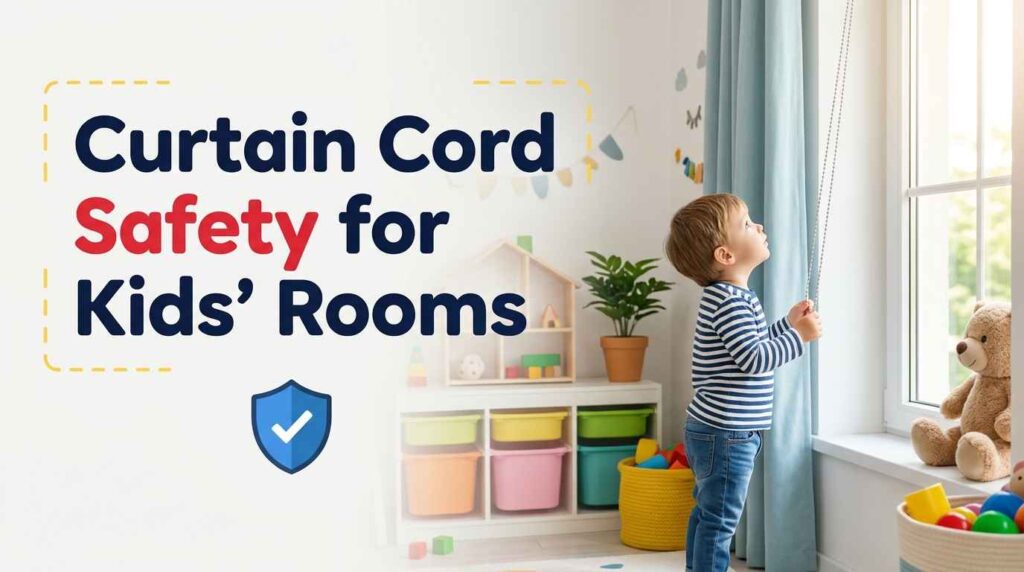
Curtain Cord Safety for Kids’ Rooms is something every parent should think about before hanging a single window treatment. Many families don’t realize that ordinary window treatments can carry a real strangulation risk, especially when a corded blinds hazard goes unnoticed in a busy toddler bedroom. The CPSC has warned parents for years about this hidden danger, yet it remains one of the most overlooked parts of home child-proofing. The good news is that window covering safety doesn’t have to be complicated. With the right choices and a few simple habits, you can boost nursery safety and give your child a room that’s both beautiful and truly safe. This guide walks you through everything you need to know, from spotting hazards to choosing the safest curtains for your child’s space.
Curtain Cord Safety for Kids’ Rooms
Curtain cord safety for kids’ rooms means choosing cordless curtains or blinds or securing any existing cords with cleats and tension devices so no loose cord hangs within a child’s reach. This simple step, backed by CPSC safety standards, is the most effective way to prevent strangulation hazards in a child’s bedroom or nursery.
H2: Why Curtain Cord Safety Matters in a Child’s Room
Curtain cord safety matters because loose or hanging cords on curtains and blinds can wrap around a young child’s neck in seconds and cause serious injury or death. This is why every parent should check their child’s room for cords that a baby or toddler could reach.
How Curtain and Blind Cords Become a Hazard
A curtain cord or blind cord looks harmless, but it becomes dangerous the moment it hangs within a child’s reach. Kids are naturally curious. They pull on things, wrap things around themselves, and climb toward things they want to touch. A dangling pull cord or a continuous loop cord can quickly turn into a loop around a child’s neck. This kind of accident often happens fast and quietly, which is why it is called a hidden hazard—most parents don’t even think of curtains as something that can hurt their child.
What the Data Says (CPSC & Safety Reports)
The Consumer Product Safety Commission (CPSC) has tracked this problem for years, and the numbers are serious. On average, about nine children under age 5 die every year from getting tangled in window covering cords. Between 2009 and 2021, CPSC recorded over 200 strangulation incidents involving children up to 8 years old—and sadly, 48% of these cases ended in death. Other children survived but were left with scars, brain damage, or paralysis. Most accidents involved venetian blinds and mini-blinds, but curtain cords carry the same risk.
Which Kids Are Most at Risk (Age Groups: Infants, Toddlers, Climbers)
Not all kids face the same level of risk. Infants and toddlers between 7 months and 4 years old are the most common victims, since this is when babies start rolling, standing, and climbing. Cords near a crib are especially dangerous—many accidents happen when a baby is left alone near a window covering for just a few minutes. As children grow older and become climbers, they may reach cords that once seemed too high, so the risk doesn’t disappear as they get bigger—it simply changes.
For a closer look at how window treatments affect little ones at different stages, check out our guides on are curtains safe for toddler rooms and are curtains safe for baby rooms.
H2: Understanding the Types of Curtain and Blind Cords
Curtain and blind cords come in different forms, such as pull cords, lift cords, and continuous loop cords, and each type carries its own level of risk for young children. Knowing the difference helps parents spot hidden dangers in their child’s room faster.
Corded Curtains vs. Corded Blinds — What’s the Difference
Corded curtains usually work with drapery cords or a traverse rod, which lets you open and close the fabric by pulling a string. Corded blinds, on the other hand, use lift cords to raise or lower the slats and often include a separate tilt wand or cord to angle the slats for light control. Both styles can leave a loose cord hanging down within a child’s reach, but blinds tend to have more cords overall because they control both height and angle, while curtains usually have just one pull cord for movement.
Continuous Loop Cords Explained
A continuous loop cord is a single cord that forms a circle instead of hanging freely with an open end. It’s common in roman shades and some curtain systems because it keeps the fabric neat and even. The problem is that this loop shape can easily slip over a small child’s head, which makes it one of the more dangerous cord designs if it isn’t anchored tightly to the wall or floor with a safety device.
Inner Cords in Cellular/Roman Shades
Inner cords run hidden inside the fabric of cellular shades and Roman shade cords, so they look safer at first glance since nothing dangles on the outside. But these cords can still form small loops between the fabric folds. If the shade is pulled or pushed unevenly, a child’s fingers or neck can get caught inside these gaps, which is why inner-cord accidents are just as serious as outer pull-cord accidents, even though the cord isn’t fully visible.
US Safety Standards and Regulations for Window Coverings

In the US, most stock curtains and blinds must be cordless or have inaccessible cords under federal safety rules that took effect in 2018. This makes it much easier for parents to find safer products off the shelf.
The 2018 CPSC/WCMA Cordless Rule for Stock Window Coverings
The Window Covering Manufacturers Association (WCMA), working with the CPSC, introduced a major safety standard called ANSI/WCMA A100.1-2018. This mandatory cordless rule requires that all stock window coverings sold in stores and online across the US be cordless or have short, hidden cords that a child cannot reach. Since stock products make up most window coverings sold in the country, this single rule protects a huge number of homes.
How to Check If a Product Meets Current Safety Standards
Before buying curtains or blinds for a child’s room, check the product labeling on the packaging. Safe products will clearly state that they are cordless or built under the current federal safety regulations. If a product still has a cord, look for a printed warning tag explaining the strangulation risk, since older or custom products may not follow the newer rules.
Understanding the “Best for Kids” Certification Mark
The “Best for Kids” label is a certification created by WCMA to help parents shop faster. Any curtain or blind carrying this label has been tested and confirmed to have no accessible cords at all, making it one of the safest choices for a child’s room.
Safest Curtain and Window Treatment Options for Kids’ Rooms
The safest window treatments for a child’s room are cordless curtains, motorized systems, or styles that never use a hanging cord at all. Choosing the right style from the start removes the hazard completely instead of just managing it.
Cordless Curtains and Drapes
Cordless curtains are the easiest choice for any kids’ room. Styles like rod-pocket curtains, grommet curtains, and tab-top curtains slide open by hand along the rod, with no pull cord involved. These are also common as ready-made curtains, so parents can buy safe options without ordering custom.
Motorized and Smart Curtain Systems
Motorized curtains and smart blinds open and close using a remote, app, or voice command, so there’s no cord anywhere near the window. This makes them a great fit for nurseries, since parents can adjust light without walking near the child’s crib.
Wand-Operated or Rod-Controlled Blinds
For families who prefer blinds, wand-controlled blinds let you tilt or raise the slats using a solid rod instead of a cord. Since there’s nothing to wrap or loop, this style avoids the biggest strangulation risks tied to traditional corded blinds.
Curtains With Magnetic or Fabric Tiebacks Instead of Cord Ties
Even tiebacks can be a hazard if they use rope-style cords. Swapping them for magnetic tiebacks or soft fabric ties removes another small but real risk from the room.
Looking for real, tested picks? See our full review of kids’ grommet curtains.
How to Retrofit Existing Corded Curtains and Blinds for Safety
If you still have old corded curtains or blinds at home, you can make them much safer using simple tools like cord cleats, tension devices, and free retrofit kits, instead of replacing everything right away.
Installing Cord Cleats and Wind-Ups
Cord cleats are small hooks that let you wrap and lock a hanging cord high on the wall, well above a child’s reach. Cord wind-ups work the same way, keeping loose cords neatly gathered instead of dangling down. Both tools are cheap, easy to install, and remove one of the biggest visible hazards in a room within minutes.
Using Tension Devices and Cord Guards
For continuous loop cords, a tension device anchors the loop tightly to the wall or floor so it can’t be pulled into a large loop. Cord guards, also known as cord shrouds, cover exposed sections of cord so a child cannot grab or wrap them. Adding a breakaway cord connector is another safety layer, since it’s designed to separate under pressure instead of staying locked around a child’s neck.
Free Retrofit Kits from Manufacturers (What to Know)
The Window Covering Safety Council offers free retrofit kits to any parent with older corded blinds or curtains. These kits usually include a cord cleat, a tension device, and sometimes cord shorteners to trim excess length. While retrofitting reduces risk, it doesn’t fully remove it—the safest long-term choice is still switching to a cordless option when possible.
Nursery and Bedroom Layout Tips to Reduce Cord Risk

Keeping cribs, beds, and furniture away from windows is one of the simplest ways to lower cord-related risks in a child’s room. Even the safest curtains can become dangerous if a child can easily climb up to reach them.
Keeping Cribs and Beds Away From Windows
Crib placement matters more than most parents realize. A crib or bed pushed against a window puts a baby within arm’s reach of any curtain or cord hanging nearby. Experts recommend moving cribs and beds to a different wall entirely so there’s no chance of contact during nap time or overnight sleep when no one is watching closely.
Furniture Placement That Prevents Climbing Access
Smart furniture arrangement goes beyond the crib. Dressers, toy chests, bookshelves, and even a changing table placed near a window can act like a step stool for a curious toddler. As kids grow, these small climbing hazards become bigger risks, especially with bunk beds near windows, where the top bunk can put a child at cord height instantly. Keep tall or climbable furniture at least a few feet from any window.
Room Layout Mistakes Parents Commonly Make
Many parents focus only on the curtain itself and forget about overall window proximity to furniture. A common mistake is assuming a cordless curtain makes the whole room safe while ignoring nearby furniture that gives a child easy access to the window area. Running through a simple child-proofing checklist for the whole room, not just the curtain, helps catch these overlooked risks.
For more on fixing curtains that are already too long for your child’s window, see our guide on what to do if curtains are too long for kids’ rooms.
Choosing the Right Curtain Length and Style for Added Safety
Curtain length matters for safety too, since long or trailing fabric can create a tripping hazard for young children moving around the room. Picking the right proportions keeps the space both stylish and safe.
Why Curtain Length Affects Child Safety Too
Floor-length curtains look elegant, but when the curtain hem pools onto the floor, it creates curtain pooling that toddlers can grab, step on, or trip over while walking or running. Trailing fabric near the ground can also tangle around a child’s feet, especially in a busy playroom or bedroom where kids move quickly and don’t watch where they step.
Recommended Lengths for Toddler and Kids’ Rooms
For most kids’ rooms, sill-length curtains are the safer choice, since the fabric ends at or just below the window sill, far from a child’s reach or path. If you prefer a longer look, aim for safe curtain proportions where the hem just skims the floor without extra fabric bunching up. This keeps the room looking finished while removing an unnecessary hazard.
For more detail on getting the right drop and fit for your child’s window, check out our guide on the best curtain length for kids’ rooms.
Curtain Cord Safety Checklist for Parents
A simple childproofing checklist can help parents catch curtain and blind cord hazards before they become a real danger. Running through these steps regularly keeps every room in the home safer for growing kids.
A Quick Room-by-Room Safety Audit
Walk through each room and do a quick cord audit: check for any dangling cords, loose loops, or cords hanging near cribs, beds, or play areas. This kind of safety inspection takes just a few minutes per room but catches hazards that are easy to miss in daily life. Make it a habit to repeat this monthly safety check, especially as your child grows taller and starts reaching higher.
Signs Your Current Curtains or Blinds Need Replacing
Some warning signs mean it’s time to upgrade. Frayed cords, missing tension devices, broken cord cleats, or products bought before 2018 are all reasons to consider replacing your curtains or blinds. It’s also worth checking the CPSC’s product recall list to see if your specific product has ever been flagged for safety issues.
What to Do If You Suspect a Recall or Unsafe Product
If you think your curtains or blinds might be unsafe or part of a product recall, you can check official government sources in just a few minutes. Taking this step gives parents peace of mind and helps prevent accidents before they happen.
How to Check for Recalled Window Coverings
The CPSC recall database lists every window covering that has ever been pulled from shelves for safety reasons. Search by brand or product name to see if your curtains or blinds appear on the list. Many manufacturers also send a manufacturer safety notice directly to registered buyers, so it’s worth registering new products when you purchase them.
Reporting a Safety Concern
If your child has been hurt, or you notice a dangerous cord issue with a product, you can file a report through SaferProducts.gov. Reporting an incident here helps the CPSC track patterns and issue new product recall actions faster, which can protect other families from the same risk.
Conclusion
Curtain Cord Safety for Kids’ Rooms is one of the simplest yet most important steps in protecting your child at home. By choosing cordless window coverings, retrofitting older curtains and blinds, and following a few basic childproofing habits like smart furniture placement and regular safety checks, you remove a hidden risk that many parents never think about until it’s too late. This isn’t just a one-time fix—it’s a long-term safety investment that keeps your child protected as they grow, climb, and explore their room. A few small changes today can give every parent lasting peace of mind, knowing their child’s space is as safe as it looks.
FAQs
1. Are curtain cords actually dangerous for kids?
Yes. A hanging or looped curtain cord can wrap around a young child’s neck in seconds, and CPSC data shows these accidents can be fatal in nearly half of reported cases.
2. What age is most at risk from window cord hazards?
Children between 7 months and 4 years old face the highest risk, since this is when babies start standing, climbing, and reaching toward things near their crib or bed.
3. Are cordless curtains more expensive?
Not usually. Most cordless curtains, like rod-pocket, grommet, and tab-top styles, cost about the same as regular ready-made curtains, so switching to a safer option rarely means a bigger budget.
4. Can I make my existing corded curtains safer without replacing them?
Yes. Adding cord cleats, tension devices, or a free retrofit kit can reduce the risk right away, though replacing them with a fully cordless option remains the safest long-term choice.
5. Do blackout curtains come cord-free?
Yes. Most modern blackout curtains use rod-pocket, grommet, or tab-top designs with no pull cord at all, making them a safe and practical choice for nurseries and kids’ rooms.
6. Is it safe to have curtains at all in a nursery?
Yes, as long as you choose cordless styles and keep the crib away from the window. Curtains themselves aren’t the danger—it’s an accessible cord near a sleeping baby that creates the real risk.

I’m Attaur Rahman, founder of DecorReviewHub. I test and review curtains and home decor products to help homeowners make the right choice for every room. All my guides are based on real use and honest comparisons.