
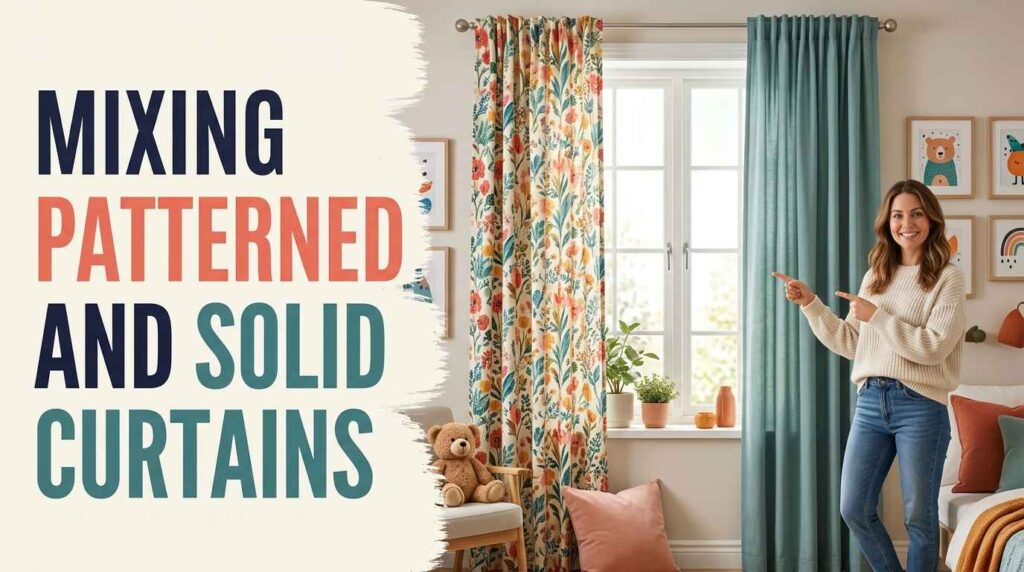
Every parent wants their kid’s room to feel fun and full of personality. But patterned curtains alone can quickly feel like too much, while an all-solid room can end up looking flat and boring. The good news is, there’s a simple way to get the best of both. Mixing patterned and solid curtains the right way gives you a room that feels playful, not overwhelming. In this guide, you’ll learn a clear, practical system built around color palette, scale, and balance—so the final result feels cohesive and put-together, not chaotic or random.
Do Patterned and Solid Curtains Have to Match?
No, patterned and solid curtains do not need to match exactly. They just need to coordinate—meaning they share a color, tone, or theme, even if the designs are different. This is the easiest way to make a kids’ room feel put together without making it boring.
Many parents think curtains have to be the “same” to look right. But that’s not true. There’s a big difference between matching and coordinating, and once you understand it, decorating gets a lot easier.
Matching means two things look almost identical—same color, same pattern, same everything. Matching can look neat, but in a kids’ room, it often feels flat and a little boring. Kids’ spaces usually work better with some fun and energy.
Coordinating is different. It means the patterned curtain and the solid curtain are connected by something—usually a shared color palette, a matching tone, or a similar style. The patterns don’t have to repeat, and the colors don’t have to be identical shades. They only have to look right side by side in one space.
For example, a curtain with a blue and white pattern can easily pair with a plain solid blue curtain. They’re not “matching,” but they clearly go together because of the shared color.
This one idea—coordinate, don’t match—is the foundation for everything else in this guide. Here’s the simple system we use to make it work every time.
The Core Rules for Mixing Patterned and Solid Curtains
Mixing patterned and solid curtains works best when you follow four simple rules: let one curtain lead, use a solid base to rest the eye, repeat one color from the pattern, and keep the whole room to 2–3 colors. These rules turn a random combo into a cohesive look.
Rule 1—Let One Curtain Lead, the Other Support
Pick one curtain to be the star. Usually, the patterned curtain is the hero, and the solid curtain plays a supporting role. If you’re layering both on the same window, the patterned panel can go in front, with the solid panel behind it. This keeps the room from feeling like two bold designs are fighting for attention.
Rule 2—Anchor with a Neutral or Solid Base
Every busy pattern needs a calm space nearby. A solid curtain, plain wall, or simple bedding gives the eye a place to rest. Without this, a patterned curtain can feel too loud, even if the pattern itself is nice.
Rule 3—Repeat One Color From the Pattern
Look at your patterned curtain and pick out one clear color from it. Use that same color for your solid curtain. This one trick instantly makes two different curtains feel connected, even if the designs don’t match.
Rule 4—Keep the Palette to 2–3 Colors
Too many colors make a room feel messy fast. Stick to 2–3 main colors total—including curtains, bedding, and a rug—for a clean, put-together kids’ room.
How Does Pattern Scale Affect Curtain Pairings?

Pattern scale means how big or small a pattern is. The safest way to mix patterns is to pair a large-scale pattern with a plain solid curtain. This is the easiest combo for beginners, and it almost always looks good.
Large-Scale Pattern + Solid Curtain
Big florals, large geometric shapes, or bold prints work best when paired with a plain solid panel. The large pattern becomes the room’s focal point, while the solid curtain keeps everything calm and balanced. This is the best starting point if you’re new to mixing patterns.
Medium-Scale Pattern + Solid Curtain
Medium-sized patterns are the most flexible option. They’re bold enough to add character but not so big that they overwhelm a small kids’ room. This size works well in almost any room style, from playful to simple.
Small-Scale Pattern + Solid Curtain
Tiny patterns—like polka dots or thin stripes—look almost like a texture from a distance instead of a full pattern. Because of this, small-scale patterns are easier to pair with a solid curtain, and they also work well if you later want to layer in a second pattern.
Rule of thumb: Never pair two patterns of the same scale. Two large patterns—or two small ones—competing together will make the room feel cluttered instead of balanced. Always mix big with small for the best visual contrast.
Matching Curtain Colors the Right Way
The easiest rule for mixing patterned and solid curtains is to pick a solid curtain in a color that’s already inside the pattern—not a random new color. This one step makes the whole room feel connected instantly.
What Solid Color Goes With Patterned Curtains?
You have two safe choices. Neutral solids—white, beige, or gray—are the most flexible option and work with almost any pattern. Accent-color solids pull the boldest color from the pattern instead, giving the room more energy and a bigger visual impact. Both are correct; it just depends on how bold you want the room to feel.
Color Examples for Kids’ Rooms
A few simple pairings make this easy to picture:
- Blue floral pattern + solid blue or white
- Pink pattern + solid blush or cream
- Green botanical pattern + solid sage or white
Each of these works is because the solid curtain shares a color with the pattern, creating natural color harmony instead of a clash.
How Many Colors Should You Use?
Stick to the 2–3 color rule from earlier. Once you pick your main pattern color and a supporting neutral, stop there. Adding more colors—even nice ones—usually breaks the room.
Which Patterns Work Best With Solid Curtains?
Almost any pattern can pair well with a solid curtain if you follow the scale and color rules from earlier. The table below shows the best solid match for each common pattern type, plus why it works so well in a kids’ room.
| Pattern Type | Best Paired Solid | Why It Works in a Kids’ Room |
|---|---|---|
| Floral / Botanical | Soft neutral or one flower color | Feels calm, great for nurseries and girls’ rooms |
| Stripe | Solid in one stripe color | Clean, gender-neutral, easy to coordinate |
| Geometric | White, gray, or navy | Modern feel, popular in boys’/gender-neutral rooms |
| Polka Dot | Solid pastel or primary color | Playful without feeling overwhelming |
| Gingham / Plaid / Check | Solid in the check’s main color | Classic look, great for farmhouse or traditional rooms |
| Animal Print / Character / Themed | Neutral solid (white, gray, tan) | Keeps the fun print as the room’s focal point |
No matter which pattern you choose, the same two rules apply: pull a color from the pattern for your solid curtain, and keep the pattern’s scale in mind so the pairing feels balanced instead of busy. This is what makes pattern coordination feel natural instead of random—even playful, themed prints like dinosaurs or space rockets follow the same simple logic as a classic floral or stripe.
Once you know which pattern you’re working with, the table above makes picking the right solid curtain almost automatic.
Layering Patterned and Solid Curtains — Same Window vs. Different Windows

There are two ways to handle mixing solid and patterned curtains in a room: use them on separate windows, or layer both on the same window with a double rod. Each option gives a different look, so it helps to know which one fits your kids’ room.
Option A—Patterned and Solid Curtains on Different Windows
This is the simplest approach. Use a patterned curtain on one window and a solid curtain on another, but keep them in the same color family. For example, a floral pattern on one window and a matching solid blue on the next window still feel connected, even though the designs are different. This option is great for parents who want an easy, low-effort way to add style without much planning.
Option B — Layering Both on the Same Window (Double Rod)
For more depth, hang two curtains on the same window using a double rod. A sheer or solid panel goes in the back, and the patterned drape hangs in front—or the other way around. This layered method gives better light control, more privacy, and a richer, more finished look. It’s also a smart choice if the room needs both daytime brightness and nighttime darkness, especially when paired with blackout curtains for kids’ rooms.
Both options work—the right one just depends on how much styling effort you want and how much light control the room needs.
Making Your Curtains Work With the Rest of the Room
Getting mixing solid and patterned curtains right isn’t just about the curtains themselves—bedding, rugs, and walls all play a part. The key rule stays the same everywhere: coordinate with color; don’t force an exact match.
How to Coordinate Curtains With Kids’ Bedding
Curtains don’t need to match the bedding exactly. They just need to share one color or a similar pattern family. The easiest combo is solid bedding with patterned curtains, or the reverse—patterned bedding with solid curtains. This keeps the room from feeling too matchy or too busy at once.
Curtains and Rugs—Should They Match?
If the rug already has a pattern, keep the curtains solid or use a small-scale print. Two bold, patterned statement pieces competing in the same room usually look cluttered instead of stylish.
Patterned Curtains With Wallpaper or Patterned Walls
If the walls have wallpaper or a pattern, solid curtains are the safer choice. But if the walls are plain or neutral, patterned curtains can become the room’s main focal point without any competition.
Pattern Mixing by Kids’ Room Style
The right way to approach mixing patterned and solid curtains depends on your room’s style. Modern rooms lean solid, boho rooms allow more layered prints, and themed rooms need one pattern balanced with a calm base.
Modern/Minimalist kids’ room—Keep curtains mostly solid. Save patterns for small accessories like pillows or a rug, so the room stays clean and uncluttered.
Boho kids’ room—This style allows more freedom. Layered, mixed prints work well here, as long as you still follow the scale rule from earlier—pair big patterns with small ones, never two of the same size.
Farmhouse kids’ room—Gingham or plaid patterns paired with a solid neutral curtain give this style its classic, cozy feel without looking too busy.
Whimsical/Themed room—Fun-themed patterns like space, animals, or characters work best when balanced with a solid base curtain or solid walls. This keeps the theme playful without overwhelming the space.
No matter the style, the same design principle applies: let the room’s personality guide how much pattern you use, but always keep a solid element nearby to balance it out.
How to Avoid Pattern Overload in a Kids’ Room
If a room feels too busy or chaotic, it’s usually a sign of pattern overload. The fix is simple: limit your patterns, use solids on big surfaces, and let one item be the star.
It’s a common problem—you love mixing patterned and solid curtains, but somehow the finished room feels overwhelming instead of fun. This usually happens when too many patterns compete at once. Here’s how to fix it:
- Limit to 2–3 patterns max in the whole room, counting curtains, bedding, and rug together
- Use solids on the largest surfaces—walls, big furniture, or the biggest curtain panel—to give the eye a resting spot.
- Vary the pattern scale so patterns don’t clash (see the scale rules above).
- Pick one statement piece and keep everything else muted and simple.
Following this checklist keeps a kids’ room feeling playful and put-together, never cluttered or chaotic.
Don’t Forget Texture and Fabric

Quick Answer: Yes, texture matters just as much as pattern. Texture works like a “quiet pattern”—it adds depth and character to a solid curtain without adding any visual clutter.
Fabrics like linen, velvet, or a woven cotton weave all carry natural texture, even in a solid color. This means a solid curtain doesn’t have to feel plain or boring. Instead, it adds a soft, layered look just through its fabric texture alone.
This is especially helpful for parents who like the idea of a bold, patterned curtain but feel nervous about committing to it. A textured solid curtain gives the room extra dimension while staying safe and simple. It’s a small detail, but it makes a big difference in how finished a room feels.
When shopping, look past just color and pattern—pay attention to how the fabric feels and catches light too.
Practical Considerations for Kids’ Room Curtains
The fabric should be washable, the lining should support better sleep, and the length should match your child’s age—these three things matter most for kids’ room curtains.
Here’s what to check before you buy:
- Washable or easy-care fabric—kids’ rooms deal with spills, sticky hands, and everyday messes.
- Blackout or room-darkening lining—helps with naps and bedtime, especially in bright rooms
- Safe hardware and proper curtain length—avoid loose cords or curtains that drag too low near young children
These details don’t affect how you’re mixing patterned and solid curtains, but they make sure the final choice is safe and practical for everyday family life.
Quick Reference — Pattern + Solid Formula Cheat Sheet
Use this 5-step formula: pick a patterned curtain, choose a solid curtain that repeats one of its colors, vary the pattern scale, limit the room to 2–3 colors, and keep large surfaces solid.
| Step | Action |
|---|---|
| 1 | Pick your patterned curtain (the statement piece) |
| 2 | Choose a solid curtain or color that repeats one pattern color |
| 3 | Vary the scale — pair a large pattern with a simpler solid, or a small print |
| 4 | Cap the room at 2–3 total colors |
| 5 | Keep large surfaces — walls, rug, furniture — mostly solid |
Conclusion
At the end of the day, mixing patterned and solid curtains in a kids’ room isn’t about finding a perfect match—it’s about coordination. When you focus on the right scale, repeat one shared color, and keep the palette simple, even the boldest patterns come together into a room that feels put-together instead of chaotic. A little restraint goes a long way, and the payoff is a space that’s fun, cozy, and truly feels like your child’s own. If you’re ready to browse more ideas, check out our full collection of kids’ room curtains, or use our free Curtain Size Calculator to make sure your next pair fits perfectly before you buy.
1. Can you mix patterned and solid curtains?
Yes. Pairing a patterned curtain with a solid one is one of the easiest ways to add style without making a room feel too busy.
2. How do you pair patterned curtains with solid curtains?
Choose a solid curtain that repeats one color from the pattern, and keep the pattern scale in mind so the two don’t compete.
3. What solid color goes with patterned curtains?
A neutral like white, beige, or gray always works. For more impact, pick the boldest color already in the pattern.
4. How many patterns are too many in a kids’ room?
Stick to 2–3 patterns total, counting curtains, bedding, and rugs together. Anything more starts to feel cluttered.
5. Should curtains match the bedding or the rug?
No. They just need to share one color or a similar style—not match exactly.

I’m Attaur Rahman, founder of DecorReviewHub. I test and review curtains and home decor products to help homeowners make the right choice for every room. All my guides are based on real use and honest comparisons.